Pallet Racking Permits in Dallas County: City-by-City Guide
8 min read · May 2026 · DFW Pallet Racking Team
Pulling a permit for a pallet racking installation in Dallas County sounds straightforward — until you realize that "Dallas County" contains dozens of municipalities, each running its own building department with its own intake forms, review queues, and requirements. What sails through in Carrollton can get stuck in Dallas city proper for weeks. This guide breaks down exactly what to expect across the major Dallas County jurisdictions so your project timeline doesn't get derailed at the permit counter.
Important Note
Permitting requirements change frequently. Always verify current requirements directly with the applicable city building department before submitting. DFW Pallet Racking manages the full engineering and permitting process for installations throughout Dallas County and the broader DFW metroplex.
Why Pallet Racking Requires a Building Permit
Many warehouse operators are surprised to learn that installing industrial pallet racking triggers the same building permit process as a structural renovation. The reason is straightforward: a fully loaded selective rack system exerts significant point loads on a concrete slab — and the International Building Code (IBC), which Texas and all Dallas County municipalities have adopted, classifies this as a structural addition that requires engineering review.
Specifically, the IBC requires permits when rack installations exceed certain height and load thresholds. In practice, virtually any commercial pallet racking system installed in a Dallas County warehouse will trigger the permit requirement. Attempting to skip the permit creates real liability exposure: your insurer may deny a claim after a rack collapse, and the municipality can require you to dismantle and re-permit the system at significant cost.
Beyond the IBC, the fire marshal review — which happens concurrently in most Dallas County cities — is often the longer-lead item. Fire suppression system engineers need to verify that rack flue spaces comply with NFPA 13 and that commodity classifications match the sprinkler head density designed into the building. If your operation stores Class III or Class IV commodities, this review can add weeks to your timeline.
City of Dallas: Development Services Department (DSD)
For installations within Dallas city limits, permits are issued through the Dallas Development Services Department. Dallas runs one of the more complex processes in the county — a reflection of both the volume of applications the department handles and the city's thorough plan review standards.
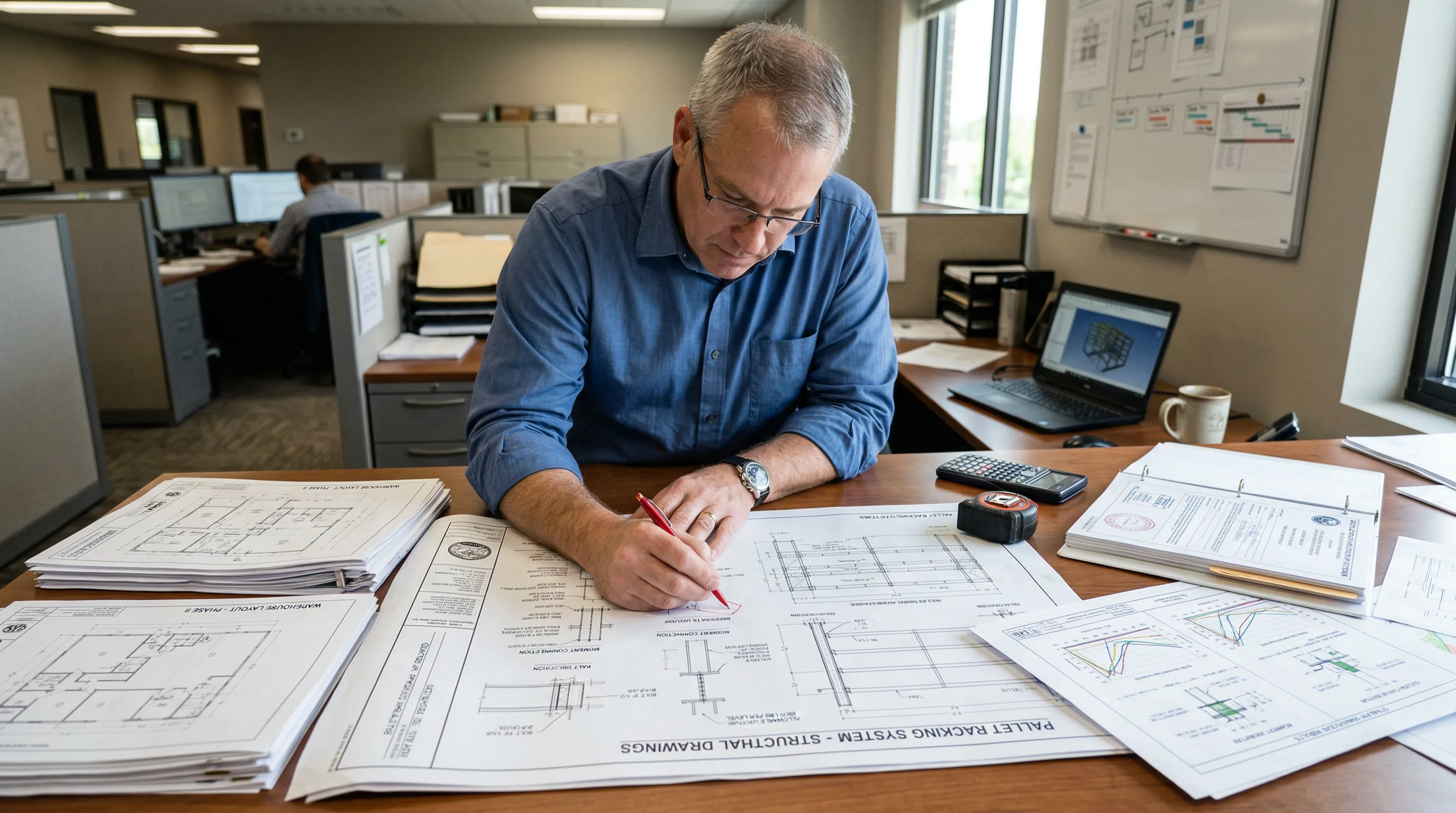
Dallas requires a complete permit package that includes stamped engineered drawings from a Texas-licensed professional engineer (PE), a site plan showing the rack layout relative to building exits and sprinkler heads, load calculations, and a floor anchor plan. The DSD has moved most submittals to its online portal, but plan reviewers still work sequentially through a queue, and review times for structural submissions typically run three to five weeks for first review.
One important nuance for Dallas city permits: the structural plan reviewer and the fire plan reviewer work from separate queues. You can submit both simultaneously, but if one reviewer comes back with comments before the other has even started, the clock resets independently for each discipline. Experienced permit expeditors submit both packages on the same day and track each queue separately. Our engineering and permitting team manages this process daily and knows how to minimize back-and-forth with DSD reviewers.
Garland: Efficient but Detail-Oriented
Garland's building department is generally regarded as one of the more efficient in Dallas County for commercial permits. The city uses an online portal and plan review turnaround for rack permits typically runs two to three weeks from a complete submission. "Complete submission" is the operative phrase — Garland reviewers will reject an incomplete package outright rather than working with the applicant, so getting your documentation right before submission matters.
Garland requires PE-stamped drawings, a rack layout plan, and documentation of the concrete slab specification — particularly slab thickness and compressive strength (f'c). If the building's original slab documentation isn't available, a field core test may be required to verify capacity before anchor bolt patterns can be approved. For older warehouse buildings in the Garland industrial corridor along I-30 and LBJ Freeway, this is worth checking before you start engineering.
The Garland Fire Marshal reviews rack permits concurrently with building plan review. Garland has a relatively active industrial base and fire staff are experienced with high-pile storage reviews, which typically keeps that portion of the review moving efficiently. Ensure your rack layout specifies flue space dimensions and commodity class — fire reviewers need that data up front.
Carrollton, Irving, and Grand Prairie: Regional Industrial Corridors
Carrollton, Irving, and Grand Prairie all have substantial industrial corridors and active building departments accustomed to processing rack permits. Each city has streamlined its commercial permitting over the past several years, and for a well-prepared submittal, turnaround times of two to four weeks are realistic.
Carrollton's industrial base is concentrated along I-35E north of Dallas and the Valwood Industrial Park. The city requires standard PE-stamped rack drawings and routes permits through a commercial plan review team. Carrollton tends to be straightforward with racking permits as long as the slab documentation and fire suppression data are included in the initial package.
Irving sits at the geographic center of the DFW metroplex, adjacent to DFW Airport, and has a high volume of warehouse and distribution activity. The Las Colinas area in Irving has seen significant industrial development, and the city's permitting office is well-versed in rack installations. Fire Marshal review in Irving can be the critical path item for large installations — particularly for buildings with rack heights exceeding 12 feet, which triggers high-pile storage review under the International Fire Code.
Grand Prairie spans both Dallas and Tarrant counties, and the building jurisdiction follows city limits rather than county lines. For facilities in the Grand Prairie industrial corridor along SH 183 and I-20, plan your submission to the correct city permit office. Grand Prairie has made significant upgrades to its online permitting system and generally processes commercial permits efficiently.
Mesquite: The Southeast Dallas County Industrial Hub
Mesquite has positioned itself as a major logistics and distribution hub, with industrial parks along I-30, US-80, and the I-635 corridor. The city's building department handles a high volume of industrial permits and has a dedicated commercial plan review track.
Mesquite requires PE-stamped rack drawings and a detailed site plan. One area to watch in Mesquite: the city has been active in enforcing fire code compliance for existing warehouses that are reconfiguring their racking layouts. If you are changing a rack configuration in an existing permitted installation — even just adding bays or changing beam heights — Mesquite may require a new permit submittal rather than an amendment. Check with the department before assuming a modification is a no-permit change.
The Mesquite Fire Marshal requires a high-pile storage permit for any installation where rack height exceeds 12 feet or where commodity storage exceeds 500 square feet. If your DFW warehouse expansion in the Dallas area involves cold storage commodities or Class IV materials, budget additional time for fire review in Mesquite.
PE Stamp Requirements Across Dallas County
Every Dallas County municipality we've covered requires engineered drawings stamped by a Texas-licensed Professional Engineer (PE) for commercial racking installations. This is not optional and is not waived for smaller systems. The PE of record must be licensed in the State of Texas and must take engineering responsibility for the structural design of the rack system.
The PE stamp covers several items: the rack structural design itself (upright gauge, beam capacity, connection design), the anchor bolt pattern and embedment depth, the connection between rack columns and the concrete slab, and the seismic design requirements for the Dallas area (which, while modest compared to California, are still required by IBC). If you're working with a national racking supplier whose engineering team is not Texas-licensed, a local PE must review and stamp the drawings — a process that adds cost and time if not planned from the outset.
Our engineering and permitting service includes Texas PE-stamped drawings prepared specifically for each city's permit requirements. We know the documentation standards that each Dallas County building department expects, which minimizes first-review comments and keeps your project on schedule.
Fire Marshal Review: The Often-Overlooked Critical Path
Every experienced racking contractor in Dallas County will tell you the same thing: the fire marshal review is frequently the critical path for large rack installations, and it's the one most operators underestimate. The International Fire Code (IFC), which all Dallas County cities enforce, requires a high-pile storage permit for rack storage of most commodity types when either rack height exceeds 12 feet or the stored footprint exceeds specific thresholds.
The fire review process examines whether the building's existing fire suppression system — typically wet-pipe sprinklers — is adequate for the proposed rack storage arrangement. This requires the applicant to provide the commodity classification (Class I through IV, or plastics), the maximum storage height, the rack configuration (selective vs. double-deep, etc.), and the aisle width. A sprinkler engineer then performs a density/area analysis to confirm that the existing heads provide adequate coverage density for the commodity and storage height proposed.
If the analysis reveals that the existing system is undersized for the proposed racking, one of two things happens: the storage configuration is changed to match what the existing system can handle, or the sprinkler system is upgraded. Either path takes time. Planning your fire suppression review early — ideally before you finalize the rack layout — gives you room to adjust without delaying the installation.
Tips for Concurrent Submission and Faster Approvals
The most effective strategy for minimizing permit timelines in Dallas County is concurrent submission — submitting structural and fire review packages simultaneously rather than sequentially. This requires having your entire documentation package complete before submitting anything, which demands more upfront coordination but saves weeks on the back end.
Work with your engineer and fire protection consultant to finalize the rack layout, commodity classification, and sprinkler analysis before either package goes in. Any change to the rack layout after submission — even minor ones — can require resubmittal and reset the review clock. Lock the layout before you submit.
Pre-application meetings, available in most Dallas County cities, are worth the time for larger projects. A 30-minute meeting with a building plan reviewer and a fire plan reviewer before submittal can surface issues that would otherwise show up as first-review comments, costing weeks. Dallas DSD, Garland, and Irving all offer pre-application consultations for commercial projects.
Let Us Handle Your Dallas County Permit
DFW Pallet Racking manages the full permitting process — PE-stamped drawings, fire marshal submittals, and permit tracking — for installations throughout Dallas County and the DFW metroplex. Get a quote today.
Get a Permitting QuoteReady to Optimize Your Warehouse?
Get a free estimate from DFW's warehouse racking experts. We serve warehouses of all sizes throughout the Dallas–Fort Worth metroplex.