Pallet Racking for DFW E-Commerce Fulfillment Centers
9 min read · May 2026 · DFW Pallet Racking Team
E-commerce fulfillment is the fastest-growing segment of the DFW warehouse market, and it's also the most demanding from a racking design perspective. Traditional distribution centers optimized for full-pallet-in, full-pallet-out movement are a poor fit for the high-SKU, high-velocity, unit-pick environment of a modern fulfillment center. Getting the racking configuration right in an e-commerce facility directly impacts pick rates, order accuracy, and the cost per unit shipped — metrics that determine whether a fulfillment operation is profitable or perpetually squeezed on margin.
DFW E-Commerce Growth
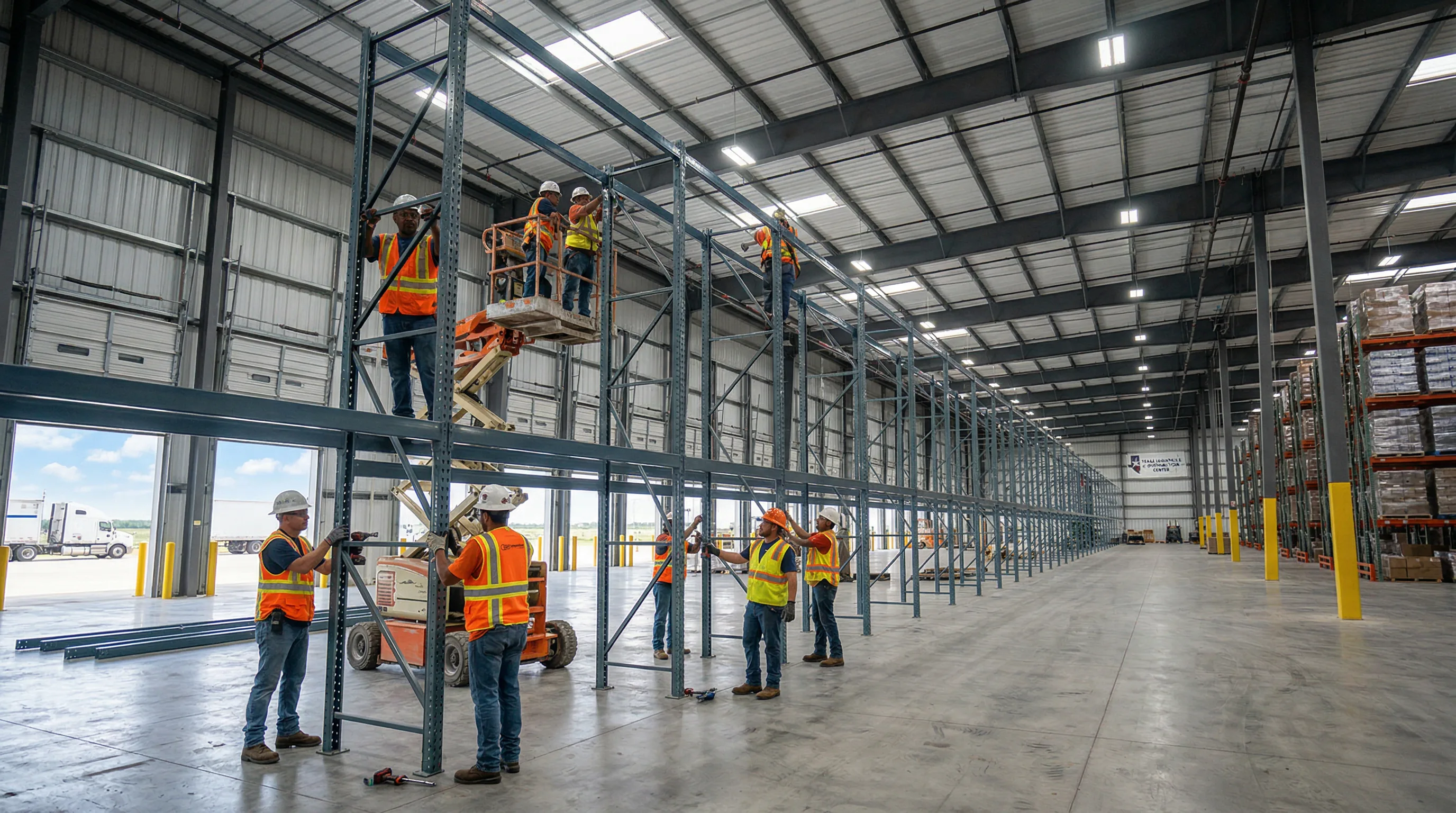
The DFW metroplex is one of the top three e-commerce fulfillment markets in the US, driven by population growth, central geography, and available industrial real estate. DFW Pallet Racking has designed and installed fulfillment center racking throughout the Frisco, McKinney, Plano, and North Dallas corridor. Contact us to discuss your fulfillment center racking needs.
How E-Commerce SKU Profiles Differ from Traditional Distribution
A traditional regional distribution center — think a grocery wholesaler or a beverage distributor — typically manages hundreds of SKUs with predictable, high-volume movement. Pallets arrive from suppliers, are staged or stored in rack, and leave in full or partial pallet quantities to retail stores. The rack system is optimized for pallet movement: wide aisles for counterbalance forklifts, deep lanes for high-turn SKUs, and relatively simple zone structures.
An e-commerce fulfillment center operates in a fundamentally different mode. Incoming freight still arrives on pallets, but outbound movement is in units — individual products picked, packed, and shipped in parcel quantities. A mid-size DFW e-commerce operation might manage 10,000 to 50,000 active SKUs, each with highly variable velocity. The top 20% of SKUs may generate 80% of pick volume (the classic Pareto distribution), but the long tail of slow-moving SKUs still needs to be accessible because a customer may order any of them at any time.
This creates a fundamentally different storage challenge: you need a system that can economically store a massive SKU range at varying densities, while making fast-moving items immediately accessible to pickers who may be walking or driving miles of pick-path per shift. Racking decisions in a fulfillment center are inseparable from labor efficiency and operational flow — which is why our warehouse design process starts with operational analysis before specifying any rack component.
Selective Racking in Fulfillment Centers: The Backbone System
Despite the proliferation of automated storage systems and specialized rack types, selective pallet racking remains the workhorse of most DFW e-commerce fulfillment centers. Its advantages — universal compatibility with forklift equipment, flexibility to reconfigure beam heights as SKU profiles change, and relatively low cost per pallet position — make it the right choice for the bulk storage and reserve storage zones of virtually any fulfillment center.
In a fulfillment center context, selective rack is typically configured differently than in a pure distribution warehouse. Beam heights are set to accommodate carton-level storage rather than just full pallets — a mix of pallet positions and carton-flow or shelving-level pick faces within the same rack bay. Slotting strategy matters enormously: A-velocity SKUs belong in the first beam levels (waist to shoulder height) in the shortest pick paths; C and D velocity items can be stored in upper rack positions or in remote bays that pickers visit less frequently.
Wire decking specification is worth careful attention in fulfillment center selective rack. Standard 4-wire waterfall decking works for full-pallet storage but is inadequate for carton-level picking, where boxes and totes need a flat, stable surface at each pick level. Flush-mount wire decks or corrugated steel decks are better suited to carton-pick environments and should be specified for all pick-face levels.
Carton Flow Rack: Driving Pick Rate in High-Velocity Zones
Carton flow rack — inclined roller or wheel-track lanes that allow cartons to gravity-feed forward as picks are made — is one of the highest-return investments in a fulfillment center racking system. For A and B velocity SKUs that are shipped in carton quantities, carton flow reduces the picker's travel distance to near zero within a product zone: the picker stands at the pick face, picks from the front, and the lane automatically advances the next unit forward.
In the DFW fulfillment centers we've worked with, carton flow zones are typically positioned at the core of the warehouse floor — closest to packing stations and conveyor systems — while selective rack reserve storage surrounds the outer zones. This minimizes travel distance for the highest-volume picks and keeps pickers in the carton flow zone for as long as possible before they need to travel to outlying rack areas for slower-moving items.
Carton flow modules integrate directly with selective rack uprights, which allows a single rack structure to contain both reserve pallet storage in the upper positions and carton flow pick faces at the lower levels. This vertical integration is important in DFW fulfillment centers where clear heights of 32 to 40 feet allow stacking multiple functions within the same rack bay footprint.
Pick-Path Design and Racking Layout
Pick-path design and racking layout are inseparable in a fulfillment center. The position of every rack bay, the width of every aisle, and the routing of every conveyor or cart path directly determines how far pickers travel per unit picked — and picker travel is typically the largest labor cost in a manual fulfillment operation.
The two dominant pick-path architectures for racking-based fulfillment are serpentine paths and zone-batch systems. In a serpentine layout, pickers travel through long rack aisles in sequence, picking items from a batch order list as they move through each zone. This minimizes setup but creates congestion when multiple pickers are working the same aisle. In a zone-batch system, the warehouse is divided into pick zones corresponding to rack sections, and orders are batched and routed to the appropriate zone pickers — reducing travel distance per pick at the cost of a more complex order management and consolidation process.
For most mid-size DFW fulfillment operations (50,000 to 200,000 square feet), the optimal approach is a hybrid: zone-based selective rack layout for the A and B velocity SKU core, with serpentine pick paths for the long-tail C and D velocity items stored in outer rack sections. This keeps zone design simple while ensuring that high-frequency picks happen in the most efficient part of the warehouse.
North DFW E-Commerce Growth: Frisco, McKinney, and Plano
The North DFW corridor — Frisco, McKinney, and Plano along the US-75 and Dallas North Tollway corridors — has emerged as one of the most active e-commerce fulfillment development zones in Texas. Population growth in Collin County has been explosive over the past decade, and the demand for rapid fulfillment to North Dallas consumers has attracted both national e-commerce operators and regional 3PL fulfillment providers to the area.
The Frisco area in particular has seen significant industrial development along the SH 121 and SH 380 corridors. New Class A industrial buildings in Frisco are purpose-built for modern fulfillment operations — 36-foot clear heights, ESFR sprinkler systems, dock-heavy configurations, and concrete slabs designed for heavy rack loads. These buildings support sophisticated racking configurations that wouldn't be possible in older warehouse stock, and they're attracting tenants with correspondingly ambitious operational requirements.
McKinney has positioned itself as a complementary market to Frisco, with industrial parks along US-75 north of the SH 121 interchange and in the Craig Ranch and Hwy 5 corridors. McKinney's lower land costs relative to Frisco make it attractive for larger fulfillment footprints where cost per square foot matters more than prestige address. Plano's older industrial corridor along US-75 and the Campbell Road area provides infill fulfillment opportunities for operations that need central North Dallas positioning over new construction amenities.
WMS Integration and Racking Configuration
Warehouse Management System (WMS) integration is no longer an afterthought in fulfillment center racking design — it's a core consideration that should influence rack configuration decisions from the earliest planning stages. The reason is straightforward: a WMS that can't efficiently direct picks and replenishment through the physical rack layout will produce suboptimal pick sequences, excessive travel, and inventory accuracy problems regardless of how well the rack is designed from a physical standpoint.
Several racking decisions have direct WMS implications. Rack numbering and location addressing must be planned in advance and must match the WMS's location hierarchy — aisle, bay, level, and position. The location addressing scheme should be logical enough for pickers to navigate without WMS guidance during a system outage. Rack bay numbering that starts at the dock end of each aisle and increments toward the back wall is the most common convention and the easiest for pickers to internalize.
Dynamic slotting — the practice of periodically reorganizing SKU-to-location assignments based on velocity changes — is only practical if the racking configuration supports it. Selective rack with standardized beam heights throughout the pick zone allows slotting changes to happen by moving product without changing the physical rack; fixed-height carton flow lanes are harder to reslot. If your WMS supports dynamic slotting (most modern systems do), ensure your rack design leaves flexibility for reslotting as your SKU profile evolves.
Flexibility for a Changing Fulfillment Environment
One of the most important — and most often underestimated — design criteria for DFW e-commerce fulfillment center racking is flexibility. E-commerce businesses change: SKU counts grow, product mix shifts, peak season volumes spike far above average, and fulfillment strategies evolve as companies scale. A racking system that's rigidly optimized for today's operation may be a liability 18 months from now.
Build flexibility into your racking investment from the start. Use standard-height uprights that can support additional beam levels if storage needs increase. Leave aisle width margins that can accommodate different pick equipment — today's manual picking operation may incorporate autonomous mobile robots (AMRs) in two years, and AMRs have specific aisle width and floor flatness requirements that are easier to accommodate if the rack configuration wasn't designed too tight. Budget for extra column guards, beam safety clips, and wire decks in your initial order — the unit cost is low and having spares on hand makes reconfigurations faster.
Design Your DFW Fulfillment Center Racking
DFW Pallet Racking designs fulfillment center racking systems throughout Frisco, McKinney, Plano, and the broader North DFW corridor. Free layout consultation and operational analysis included.
Get a Fulfillment Center LayoutReady to Optimize Your Warehouse?
Get a free estimate from DFW's warehouse racking experts. We serve warehouses of all sizes throughout the Dallas–Fort Worth metroplex.