Forklift Aisle Width and Pallet Racking: A Practical Guide for DFW Warehouses
8 min read · May 2026 · DFW Pallet Racking Team
Aisle width is one of the most consequential decisions in any warehouse racking project — and it's one that gets locked in early. Pick the wrong aisle width for your forklift fleet and you'll either waste valuable floor space or end up with equipment that can't safely maneuver between racks. This guide walks through what DFW warehouse operators need to know before they finalize their layout.
Key Takeaway
Aisle width must be matched to your forklift type — not the other way around. Retrofitting equipment to fit an already-built rack layout is expensive and often impossible. Always finalize your equipment list before committing to a racking plan. DFW Pallet Racking provides warehouse design and space planning services that coordinate rack layout with equipment specs.
Why Aisle Width Matters More Than It Seems
Every inch of aisle width you add takes space away from storage. In a 50,000-square-foot DFW warehouse, the difference between 12-foot aisles and 10-foot aisles can translate to dozens of additional pallet positions — or in a tight facility, an entire additional rack row. Across the Dallas–Fort Worth industrial market, where lease rates per square foot have climbed steadily over the past several years, those extra positions have real dollar value.
At the same time, undersized aisles create real danger. A forklift operating in an aisle that's too narrow for its turning radius will clip rack uprights. Even low-speed impacts can bend uprights enough to compromise rack integrity, and cumulative damage from daily near-misses is one of the leading causes of warehouse rack failures. The cost of replacing bent uprights — and the liability from a racking incident — far outweighs any storage density gain.
Getting aisle width right is fundamentally about matching your racking layout to the actual equipment that will operate in your facility. That match needs to happen before the first anchor hole is drilled.
Standard Counterbalance Forklifts: Wide Aisles, Maximum Flexibility
The standard sit-down counterbalance forklift — the most common type in DFW distribution and manufacturing facilities — requires the widest aisles of any warehouse forklift. Typical aisle requirements for counterbalance trucks range from 11 to 13 feet, depending on the truck's turning radius and the length of the pallets being handled. Larger trucks with 72-inch forks handling 48-inch deep pallets in selective racking typically need 12-foot minimum aisles to safely turn and place loads.
The wide aisle requirement is the tradeoff for versatility. Counterbalance forklifts can handle a wide range of load types, operate indoors and outdoors, and require less operator training than specialized narrow-aisle equipment. For DFW warehouses that handle mixed SKUs, irregular loads, or frequent cross-dock operations, counterbalance trucks with standard aisles remain the most practical choice.
In DFW's older industrial submarkets — parts of Dallas, Grand Prairie, and southern Fort Worth — building column spacing often dictates aisle layout. Older tilt-up buildings with 40- to 50-foot column grids may force specific rack depths and aisle widths regardless of equipment preference. A warehouse design professional can help you work within those constraints.
Reach Trucks: The Narrow Aisle Middle Ground
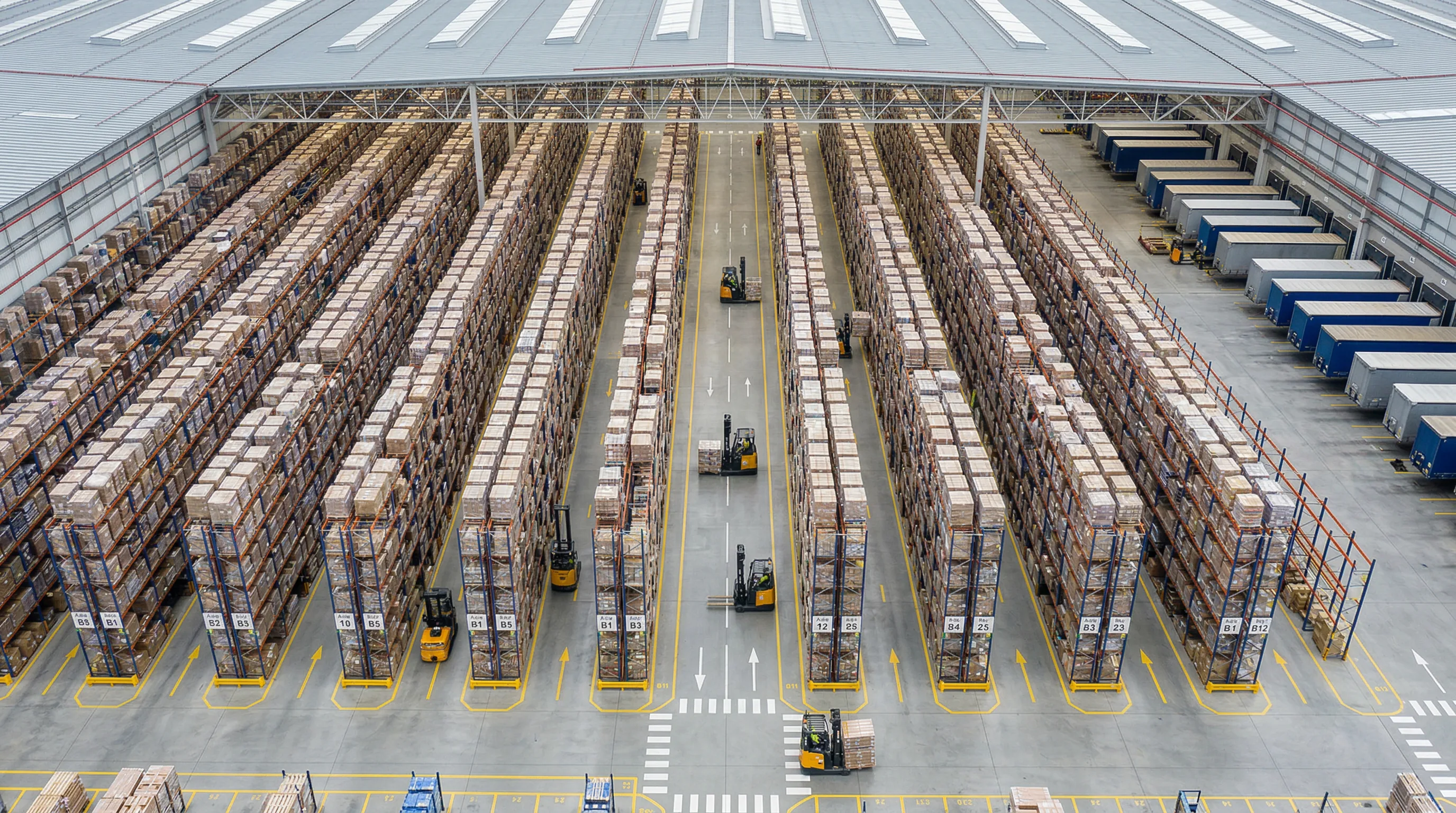
Electric reach trucks are the most common narrow-aisle solution in DFW warehouses. Reach trucks typically operate in aisles of 8.5 to 10 feet — roughly 20 to 30 percent narrower than counterbalance aisles — and can reach rack heights of 30 feet or more, making them well-suited to the high-clear buildings common in Plano, Frisco, and the I-35W corridor near Fort Worth.
The reach mechanism allows the forks to extend forward independently of the truck body, which is what enables the narrower aisle. The tradeoff is that reach trucks are indoor-only, require flatter and better-maintained floors than counterbalance trucks, and have a steeper operator learning curve. They're also generally slower than counterbalance trucks, which matters in high-throughput operations.
For DFW warehouses that are storage-dense — high SKU counts, lots of reserve storage, or facilities where rent costs make every square foot count — reach trucks with narrow-aisle racking are frequently the right call. The initial equipment investment is higher, but the storage density gains typically justify the cost in facilities over 30,000 square feet.
Very Narrow Aisle (VNA) Equipment: Maximum Density, Maximum Commitment
Very Narrow Aisle (VNA) forklifts — also called man-up order pickers or turret trucks — operate in aisles as narrow as 5.5 to 6 feet. This represents a dramatic increase in storage density compared to conventional layouts. A facility that runs VNA equipment can often fit 40 to 60 percent more pallet positions in the same footprint as a standard counterbalance layout.
However, VNA is a significant operational commitment. Turret trucks require wire guidance or rail systems embedded in the floor. Floors must be extremely flat — typically within F-number specifications far tighter than standard warehouse slab tolerances. VNA equipment is expensive to purchase and maintain, and operators require specialized certification. In a fire, evacuation from VNA aisles is also a safety consideration that must be addressed in your emergency action plan.
In the DFW market, VNA installations are most common in large distribution centers and third-party logistics (3PL) operations — particularly in the Alliance corridor near Fort Worth, where large-format modern facilities can accommodate the floor flatness and infrastructure requirements. For most small to mid-size DFW warehouses, reach trucks offer a better balance of density and operational flexibility.
How DFW Building Column Spacing Affects Aisle Planning
One factor that gets less attention than it deserves is the building's structural column grid. In the DFW metroplex, you'll encounter a wide range of column spacings depending on when and where the building was constructed. Older facilities in older industrial parks often have column grids of 40 by 40 feet or 40 by 50 feet. Newer spec buildings in growth corridors like Frisco, McKinney, and the I-20 corridor tend to have 50-by-52-foot or 52-by-56-foot column grids — or even wider.
Column spacing directly affects how you can lay out rack rows and aisles. In a 40-foot column bay, you might fit one rack row plus one aisle; in a 52-foot bay, you might fit two rack rows plus an aisle, or one rack row plus a wider aisle. Getting the math right requires precise measurement of the column grid and coordination between rack depth, beam configuration, and aisle width targets.
Our warehouse design and space planning team handles this kind of layout optimization regularly for DFW facilities. We work from building drawings and field measurements to develop layouts that maximize pallet positions within your column grid, dock position constraints, and equipment requirements. See our Dallas warehouse design services for more information.
OSHA 1910.178: The Federal Aisle Width Requirement
OSHA 29 CFR 1910.178(n)(1) requires that aisles used by powered industrial trucks must be at least three feet wider than the widest vehicle or load traveling through the aisle. For a standard 48-inch-wide pallet handled by a counterbalance forklift, this means a minimum aisle width of 84 inches — 7 feet — before the forklift's own width is factored in. In practice, the forklift's turning radius and load handling requirements set the real minimum well above that floor.
OSHA 29 CFR 1910.22 additionally requires that aisles be kept clear and unobstructed, and that they be marked with floor paint or other visible demarcation. Both requirements are commonly cited in DFW warehouse inspections. Aisle markings that fade, become obscured by pallets, or that were never applied in the first place are among the most frequent OSHA findings in warehouse compliance audits.
For pedestrian aisles not used by powered equipment, the minimum width is 28 inches. In facilities where pedestrians and forklifts share aisles, additional protections — pedestrian barriers, warning systems, or strict traffic management procedures — are typically required to meet OSHA's general duty standard.
The Density vs. Accessibility Tradeoff
Every warehouse operator eventually confronts the core tension in racking design: narrower aisles mean more pallet positions, but they also mean slower pick speeds, higher equipment costs, and less operational flexibility. There is no universally correct answer — the right tradeoff depends on your specific business model.
High-velocity operations with rapid inventory turns — like food distribution or e-commerce fulfillment — often benefit more from wide aisles and fast throughput than from maximum storage density. The time cost of slow picks and tight maneuvering adds up quickly when you're pulling hundreds of orders per day. In these operations, counterbalance forklifts with standard aisles frequently outperform narrow-aisle systems even if they use more floor space.
Storage-intensive operations — bulk storage, reserve inventory, seasonal goods — typically favor narrower aisles and higher density, since throughput speed matters less than maximizing the number of pallets you can store. Reach trucks in 9-foot aisles are a natural fit for these operations, especially in DFW facilities where the combination of high clear heights and narrow aisles can dramatically increase total pallet capacity without adding square footage.
Getting the Right Layout Before You Order Rack
The most expensive aisle width mistakes are the ones that get built. Reconfiguring a racking system after installation — relocating rows, adjusting depths, changing configurations — means unloading inventory, disassembling hardware, and potentially redrilling anchor points in your slab. It's time-consuming, disruptive, and costly. A professionally developed layout plan done before installation eliminates that risk.
DFW Pallet Racking develops detailed CAD-based layout drawings that show exactly where each rack row goes, what the aisle widths will be, how the layout interacts with your column grid and dock positions, and how many total pallet positions the finished system will deliver. We coordinate with your equipment vendor or your existing fleet specs to ensure the aisles we design are appropriate for the trucks that will operate in them.
Get a Free Warehouse Layout Assessment
We'll evaluate your DFW facility, forklift specs, and storage goals to develop a racking layout that maximizes pallet positions without compromising operational efficiency.
Request a Layout AssessmentReady to Optimize Your Warehouse?
Get a free estimate from DFW's warehouse racking experts. We serve warehouses of all sizes throughout the Dallas–Fort Worth metroplex.