Fort Worth Pallet Racking: The Complete Guide for Tarrant County Warehouses
9 min read · May 2026 · DFW Pallet Racking Team
Fort Worth and Tarrant County have become one of the most active warehouse and distribution markets in North America. From the massive AllianceTexas logistics corridor in the north to the industrial parks along I-20 in the south, Tarrant County is absorbing millions of square feet of new distribution space every year — and every one of those buildings needs properly engineered, permitted, and installed pallet racking. This guide covers everything Fort Worth warehouse operators need to know.
Local Expertise
DFW Pallet Racking installs, inspects, and permits racking systems throughout Fort Worth and Tarrant County. Our crews are on-site in the Fort Worth area weekly. Call us for a same-week site assessment.
The AllianceTexas Corridor: North Fort Worth's Logistics Engine
AllianceTexas is a 27,000-acre master-planned community anchored by the Fort Worth Alliance Airport — the world's first industrial airport, purpose-built for cargo operations. The Alliance corridor stretches from Loop 820 in the south to the Denton County line in the north, and it has attracted a concentration of 3PLs, national retailers, manufacturers, and e-commerce fulfillment operators that rivals any logistics market in the country.
The warehouse buildings in Alliance are generally newer construction, with clear heights ranging from 32 to 40 feet and sometimes higher. This matters for racking because taller clear heights support more rack tiers, larger column sections, and heavier beam loads — all of which require more sophisticated engineering. Rack systems in Alliance warehouses frequently reach 30+ feet in height, making proper engineering, PE-stamped drawings, and fire suppression compliance non-negotiable.
The Alliance corridor also benefits from rail infrastructure — BNSF's Alliance Terminal operates adjacent to the airport — which means many Alliance tenants handle mixed freight that includes both standard palletized goods and oversized or odd-lot inventory. Racking designs in Alliance warehouses often incorporate a mix of selective rack, drive-in rack for deep-lane storage, and floor-loaded areas for items that don't fit standard rack configurations.
South Fort Worth and the I-20 Industrial Corridor
While Alliance dominates the headlines, South Fort Worth has its own substantial industrial base along I-20, SH 183, and the Granbury Road corridor. South Fort Worth warehouses tend to be older stock — many are 1980s and 1990s tilt-wall buildings with clear heights of 24 to 28 feet — and they house a mix of manufacturing, building materials distribution, and regional 3PL operations.
Older South Fort Worth buildings present specific racking challenges. Concrete slabs may be thinner (4–5 inches versus the 6–7 inch slabs typical in modern spec buildings) and compressive strength documentation is often unavailable. Before engineering anchor patterns for rack uprights, a slab core test is frequently necessary to confirm f'c values and slab thickness. Our team conducts these assessments as part of our pre-project site survey.
The Everman, Crowley, and Kennedale submarkets along and south of I-20 are growing rapidly as land constraints in central Fort Worth push industrial users farther out. These smaller suburban cities in southern Tarrant County each have their own building departments and permit processes — a consideration for any installation that crosses city boundary lines within a single business park.
Common Rack Types in Fort Worth Warehouses
The mix of warehouse types across Tarrant County means that no single rack configuration dominates the market. Here's what we see most frequently across Fort Worth area facilities:
Selective pallet racking remains the most common system across all submarket types. It works in virtually any warehouse, provides direct access to every pallet, and is the most cost-effective option for operations with moderate to high SKU counts. In the Alliance corridor, selective rack is typically installed to full clear height — 32 to 36 feet — with wire decking and seismic anchoring per IBC requirements.
Drive-in and drive-through rack is common in food and beverage distribution operations throughout Tarrant County. Fort Worth has a significant food distribution presence, with several major grocery wholesalers and regional food manufacturers operating large distribution centers. Drive-in rack maximizes pallet density for operations with relatively few SKUs and high turnover by product class rather than individual unit.
Push-back rack is growing in popularity in Fort Worth's e-commerce and consumer goods distribution centers, particularly in the Alliance corridor. Push-back systems offer LIFO selectivity with higher storage density than selective rack — typically 2 to 5 pallets deep — without the forklift traffic complexity of drive-in systems. They work well for operations where each lane stores a single product or SKU family with consistent replenishment.
Fort Worth Building Permits for Rack Installations
Fort Worth processes commercial building permits through its Development Services Department. The city has invested significantly in its digital permit portal over the past several years, and online submission is now the standard path for commercial racking permits. Full electronic plan sets — including PE-stamped structural drawings and fire suppression documentation — can be submitted and reviewed entirely online.
Fort Worth's plan review process for commercial racking typically takes three to four weeks from complete submittal for first review. The city uses a commercial plan review team for structural submittals and routes fire-related components to the Fort Worth Fire Department's plans examination division. These two reviews run concurrently, but the fire review is frequently the longer-lead item for high-pile storage facilities.
An important Fort Worth-specific requirement: the city enforces the International Building Code with local amendments adopted by Tarrant County. One local amendment that affects racking is the city's seismic design requirement — Fort Worth sits in a low-seismic zone but does require that racks be designed to IBC seismic provisions, which affects anchor bolt sizing and connection detailing. Your PE must account for this in the structural drawings. Our installation team works with PE partners who know Fort Worth's local amendments cold.
Tarrant County Suburban Cities: Haltom City, Richland Hills, Hurst, Euless, Bedford
The Mid-Cities area between Fort Worth and Dallas — Hurst, Euless, Bedford, and neighboring communities — has its own cluster of industrial properties, particularly in the DFW Airport adjacent areas. These cities maintain independent building departments, and permitting experiences vary significantly. Euless and Bedford tend to process commercial permits relatively quickly; Hurst and Haltom City both have smaller permit offices that can experience backlogs during high-activity periods.
For any installation in the Mid-Cities corridor, we recommend confirming the applicable jurisdiction before starting engineering. DFW Airport's immediate surroundings straddle multiple city limits, and it's not uncommon for a single business park to contain buildings permitted under two or three different jurisdictions. Getting the jurisdiction wrong early means engineering drawings stamped with the wrong city's code requirements — a costly mistake that delays the entire project.
Haltom City and North Richland Hills, situated along Loop 820 north of Fort Worth, have seen significant warehouse and light industrial development. Both cities' building departments are familiar with commercial rack permits, and the industrial concentration in this corridor means fire marshals in these cities have direct experience with high-pile storage reviews.
Alliance Airport Logistics Demand and What It Means for Racking
Fort Worth Alliance Airport handles more cargo tonnage annually than Dallas Love Field and many other major regional airports combined. The mix of cargo flowing through Alliance — consumer electronics, automotive parts, perishables, pharmaceuticals, and e-commerce freight — drives demand for specialized racking configurations that go beyond basic selective systems.
Pharmaceutical and healthcare supply chain operations near Alliance frequently require temperature-controlled storage areas with racking specifications that account for cold room environments. Electronics distribution operations prioritize static-control floor surfaces, ESD-safe racking accessories, and rack configurations optimized for carton picking rather than pallet-in/pallet-out movement. Automotive parts distribution — a major segment in the Alliance corridor given Fort Worth's proximity to the GM, Lockheed, and naval aviation supply chains — typically involves a mix of heavy-duty selective rack for bulk parts and bin shelving or mezzanine-integrated systems for small parts and hardware.
The Fort Worth area continues to attract major distribution investment, and we expect demand for sophisticated racking configurations — including automated storage integration, mezzanine systems, and high-bay very narrow aisle (VNA) systems — to grow as new Class A buildings come online in the Alliance corridor through 2027 and beyond.
Rack Inspection Requirements for Fort Worth Warehouses
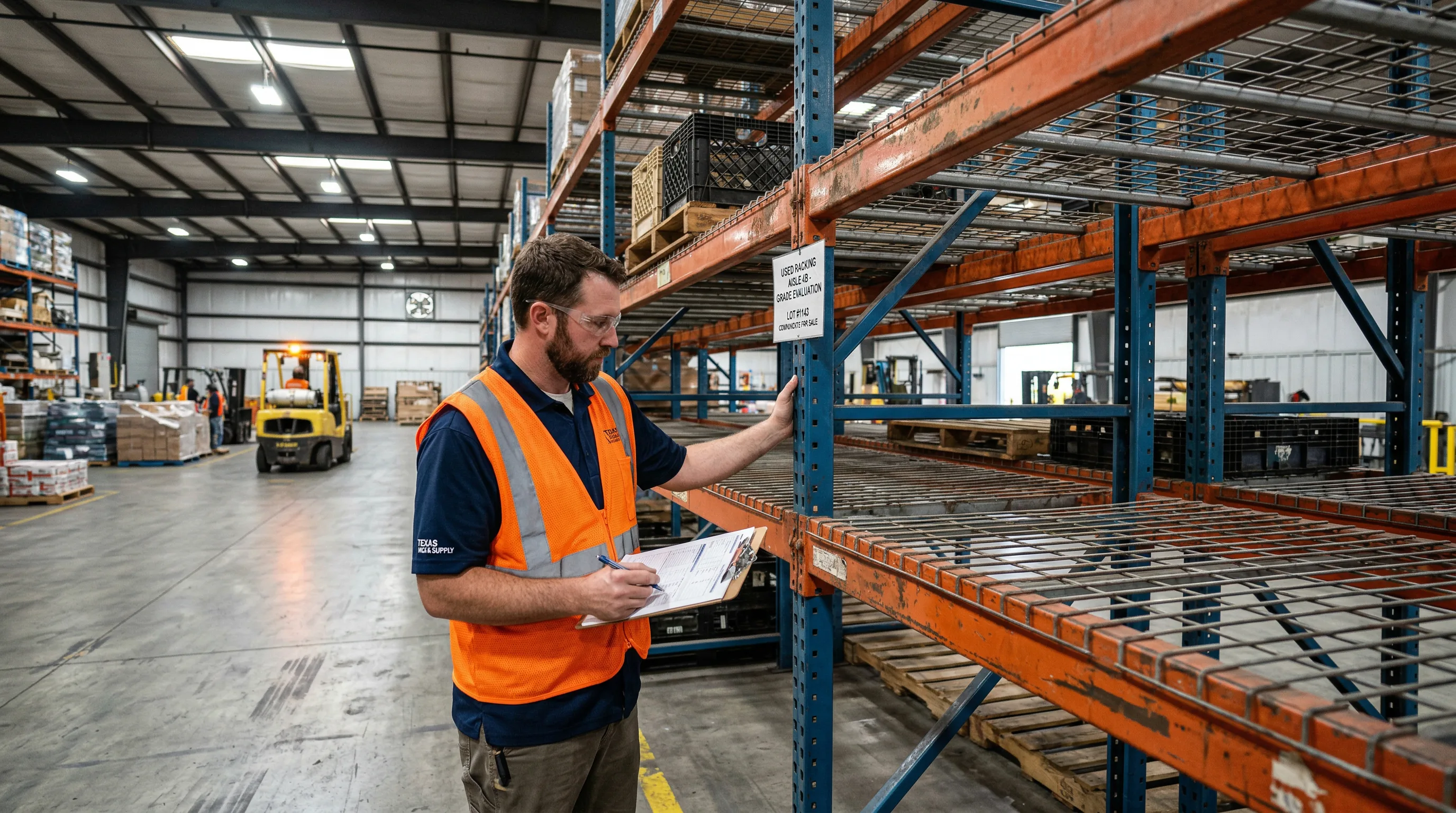
OSHA's General Duty Clause and ANSI/RMI MH16.1 require that pallet racking be inspected at regular intervals by a qualified person. For Fort Worth area warehouses, this means a formal annual inspection at minimum — with post-impact inspections required immediately after any forklift contact with rack components.
Fort Worth Fire Department enforcement has intensified in recent years around high-pile storage compliance, particularly for operations in buildings that were originally permitted for lower storage heights than are currently in use. If your Fort Worth warehouse has grown its storage height since the building was originally permitted, a re-permit may be required — and a formal rack inspection report is typically part of that process.
DFW Pallet Racking conducts formal rack inspections throughout Tarrant County and provides written inspection reports that document each component, flag damage ratings per ANSI/RMI color coding (green/yellow/red), and provide a prioritized repair list. This documentation protects you in an OSHA audit and supports your insurance carrier's requirements for maintaining coverage on rack systems.
Planning a New Racking Installation in Fort Worth
The most important step before any Fort Worth racking project is a thorough site survey. Slab evaluation, building column grid, existing sprinkler head layout, door and dock locations, utility conflicts, and clear height verification all affect the racking design. Skipping the site survey and designing from building drawings alone — especially for older Tarrant County buildings where as-built conditions frequently differ from original plans — is a common source of change orders and project delays.
Our process starts with a no-charge site visit and layout consultation. We review your operational requirements, measure the building, document slab and structural conditions, and produce a concept layout before any engineering fees are committed. This gives Fort Worth warehouse operators a realistic picture of what's achievable in their specific building before the permitting process begins.
Fort Worth Racking Quote — Same-Week Site Visit Available
Our team is active throughout Fort Worth, AllianceTexas, and all of Tarrant County. Contact us for a free site assessment and racking proposal.
Schedule a Site VisitReady to Optimize Your Warehouse?
Get a free estimate from DFW's warehouse racking experts. We serve warehouses of all sizes throughout the Dallas–Fort Worth metroplex.