Pallet Racking for DFW Manufacturers: Storage Solutions for Production Facilities
9 min read · May 2026 · DFW Pallet Racking Team
Manufacturing facilities present storage challenges that pure distribution centers don't face. When your building serves double duty as a production environment and a warehouse, the demands on your storage system are layered — you need to support raw material staging, work-in-process storage, finished goods holding, and often the distribution of product to customers, all within a single facility. This guide covers how DFW manufacturers can approach racking and storage system design to support production workflows without compromising safety or efficiency.
Manufacturing Storage Tip
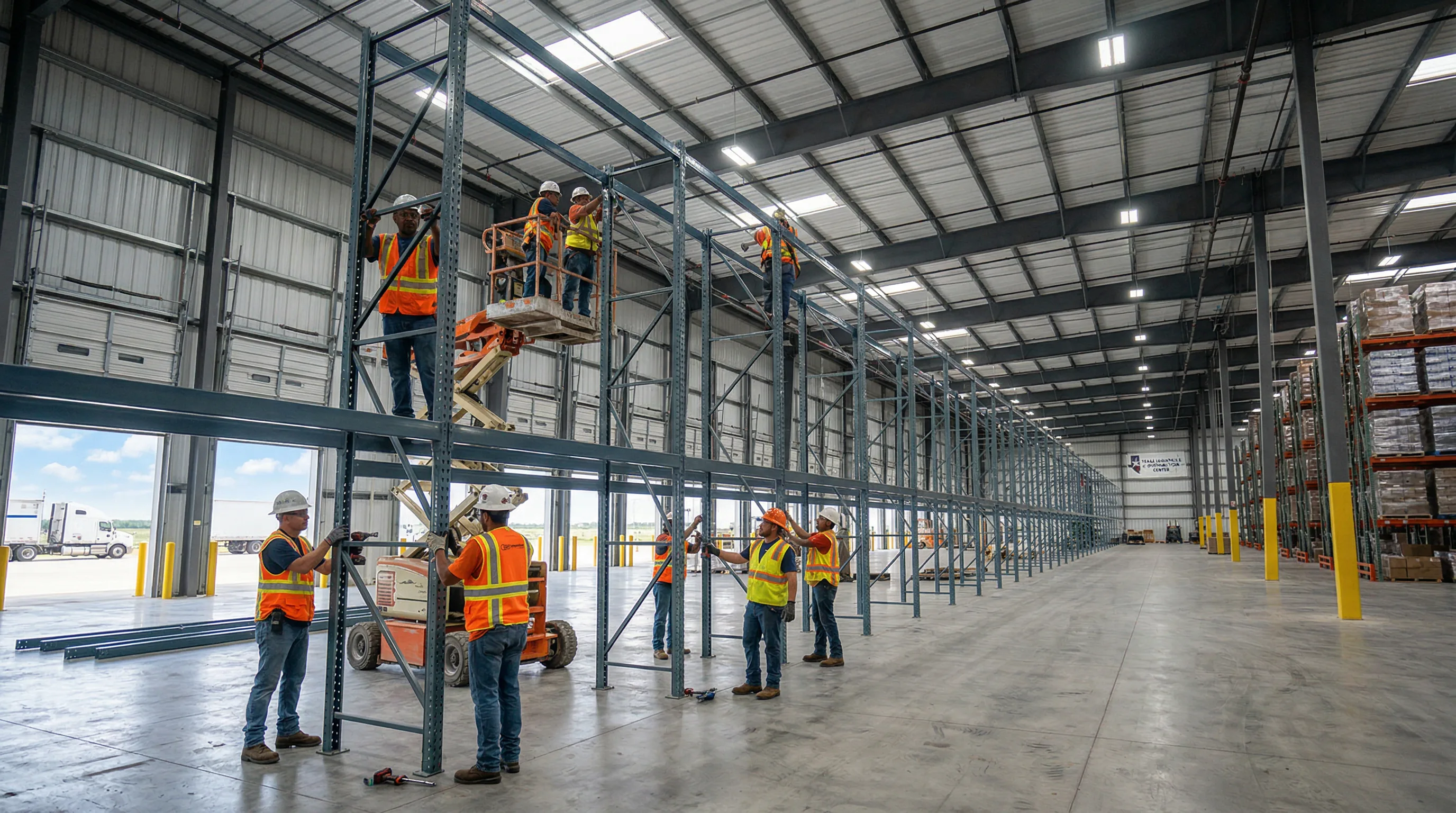
Manufacturing facilities often need multiple rack system types in a single building — pallet rack for finished goods, cantilever for long material, wide-span for parts and hardware, and floor-level staging areas near production equipment. An integrated layout plan that coordinates all these elements avoids the expensive mistakes that come from adding systems piecemeal. DFW Pallet Racking provides full-facility installation services for DFW manufacturers.
How Manufacturing Workflow Affects Rack Layout
The fundamental difference between a manufacturing facility and a distribution center is the presence of production equipment and active work-in-process. In a distribution center, the flow is simple: receive, store, pick, ship. In a manufacturing facility, material must flow from receiving to raw material storage, then to production staging, through various production stages, into work-in-process storage between operations, and finally into finished goods storage before shipping. Each stage has different storage requirements.
This complexity means that rack layout in a manufacturing facility must be designed around the production flow — not the other way around. Raw material storage should be positioned to minimize travel distance from receiving docks to the first production operation. Finished goods storage should be positioned close to shipping docks. Work-in-process storage needs to be accessible to the specific production equipment it serves, which often means integrating rack into the production floor rather than concentrating it in a separate warehouse area.
Production scheduling also affects rack design in ways that don't apply in distribution. If your facility runs batch production — making large quantities of each product before switching — your finished goods storage needs to accommodate large accumulations of a single item. If you run mixed-model production with frequent changeovers, finished goods may be more diverse but shallower, which favors selective racking over high-density systems. Understanding your production model before designing rack is as important as understanding your inventory profile.
Raw Material Storage: Matching System to Material Type
Raw material storage requirements vary enormously across DFW's manufacturing base, from sheet metal and pipe in metal fabrication shops to bagged resins in plastics processors to components and sub-assemblies in assembly operations. The first step in designing raw material storage is categorizing materials by form factor: palletized, long and cylindrical, sheet goods, boxed components, or bulk loose material.
Palletized raw materials — bags, drums, cartons, boxes — are the simplest to address with standard selective pallet racking. The key consideration is storage depth versus throughput. If your production line pulls the same material daily, single-deep selective rack with full FIFO access is usually best. If you receive large quantities of material infrequently and want to store multiple pallets deep to minimize dock activity, double-deep or drive-in configurations may be more efficient.
For raw materials that arrive in non-palletized form — particularly long goods like bar stock, tube, angle iron, sheet metal, and lumber — standard pallet racking is the wrong tool. These materials require cantilever rack, which is designed specifically for long, awkward items that can't be supported on standard pallet beams. We cover cantilever rack in detail below.
Cantilever Rack for Long Material: The Manufacturing Standard
Cantilever racking is the storage system of choice for DFW manufacturers who handle long or irregularly shaped raw materials. Unlike standard pallet rack, cantilever rack has no front columns — only a vertical spine with horizontal arms that extend outward. This open-face design allows material of any length to be loaded and retrieved from the front without obstruction.
Cantilever arms are available in lengths from 24 to 60 inches or more, and arm capacity typically ranges from a few hundred pounds to over a thousand pounds per arm. Systems can be configured for single-sided or double-sided access, allowing back-to-back installation in the middle of a facility. Height depends on your forklift's reach and the clear height of your building — in many DFW manufacturing facilities, cantilever rack reaches 15 to 20 feet.
DFW manufacturers in industries including steel service, pipe and fittings, lumber, plastics, and fabricated metal products commonly use cantilever rack as a core part of their raw material storage strategy. The system is also used for finished goods in industries where products are too long for standard pallet rack — finished pipe, extrusions, panels, and similar items. If your facility handles material over 8 feet long in any significant quantity, cantilever rack deserves serious consideration.
Wide-Span Shelving for Parts, Hardware, and Sub-Assemblies
Assembly operations and manufacturers with complex bills of materials often need storage for dozens or hundreds of distinct component types — hardware, fasteners, sub-assemblies, purchased components, and tooling. This type of inventory typically doesn't come on pallets, is accessed by hand rather than forklift, and needs to be organized for quick manual retrieval by production workers.
Wide-span shelving — sometimes called bulk shelving or industrial shelving — is designed for exactly this application. Unlike pallet rack, which is engineered for forklift loads, wide-span shelving is designed for hand-stacked loads and provides bin-level organization at worker-accessible heights. Shelf dimensions typically range from 36 to 96 inches wide and 24 to 48 inches deep, with shelf capacities from a few hundred to a few thousand pounds per level.
In DFW manufacturing facilities, wide-span shelving is commonly used in parts rooms, tool cribs, maintenance areas, and along production lines for in-process component storage. It can also be integrated into mezzanine systems to create multi-level parts storage above production equipment, effectively using airspace that would otherwise be wasted. Our team designs and installs wide-span shelving systems throughout the DFW manufacturing market, often as part of integrated storage solutions that combine pallet rack, cantilever, and shelving within a single facility.
Floor-Level Staging Zones Near Production Equipment
Not everything in a manufacturing facility belongs on a rack. Production floor staging areas — where material waits to be loaded into a machine, or where finished product accumulates before moving to the next operation — typically need floor-level access, not vertical storage. Trying to force these workflows into rack systems creates congestion, slows production, and creates safety hazards as workers try to maneuver around forklift-height systems in pedestrian production areas.
Good manufacturing storage design carves out designated floor-level staging zones at key points in the production flow. These zones should be sized for your actual workflow — large enough to accommodate the buffer stock your process needs without spilling into aisles or production areas. Floor marking and visual management systems help keep staging zones organized and prevent the creep of inventory into aisles and walkways.
The integration of floor staging zones with adjacent rack systems requires careful coordination. Forklift aisles that serve rack must connect cleanly to staging zones without creating dead ends or forcing forklifts to make multi-point turns in tight spaces. Getting this layout right requires thinking about material flow holistically — understanding not just where things are stored, but how they move through the facility during a production shift.
OSHA Requirements in Manufacturing Environments
OSHA regulations for racking in manufacturing facilities draw from two overlapping bodies of standards: the general warehouse and storage rules that apply to distribution centers (29 CFR 1910.176 and 1910.22), plus manufacturing-specific regulations that apply to pedestrian-forklift interaction and machine guarding in production areas.
The most practically significant OSHA concern for manufacturers is the intersection of pedestrian production workers and powered industrial trucks. OSHA 29 CFR 1910.178 governs forklift operation, and in manufacturing environments — where workers on foot and forklifts operating in close proximity is common — the requirements around pedestrian protection, aisle marking, and forklift speed are strictly enforced. Rack positioning that forces forklifts to operate near production workers significantly increases your exposure.
Manufacturing facilities also face requirements under 1910.147 (lockout/tagout) when rack maintenance is performed near energized production equipment, and under 1910.212 (machine guarding) when rack is positioned near moving machinery. If your rack is adjacent to production equipment, these requirements need to be factored into both the layout and your maintenance procedures. Our installation team is familiar with manufacturing-environment requirements and coordinates with facility safety teams on complex projects.
DFW Manufacturing Submarkets: Fort Worth, Denton, and Garland
DFW's manufacturing base is distributed across several distinct submarkets, each with its own industrial character. Fort Worth has a strong manufacturing tradition rooted in aerospace and defense, food processing, and metal fabrication. The city's west and south industrial areas host many long-established manufacturers that operate in older buildings with lower clears and more constrained layouts. The Alliance corridor in north Fort Worth is home to newer manufacturing operations in modern facilities.
Denton, at the northern apex of the Metroplex, has grown significantly as a manufacturing and logistics location over the past decade. The availability of larger land parcels, reasonable lease rates, and access to I-35E and US-380 have attracted distribution and light manufacturing operations that need room to grow. Denton's building stock trends newer than Fort Worth's legacy industrial areas, and clear heights in the 28-to-32-foot range are increasingly common. See our Denton pallet racking services for more information on this growing submarket.
Garland, in eastern Dallas County, is one of DFW's most established manufacturing cities, with a deep concentration of metal fabrication, electronics, food processing, and industrial manufacturing operations. Garland's building stock is mixed — older facilities from the 1960s through 1980s exist alongside more recent construction — and manufacturers here often deal with the constraints of older buildings while managing complex production storage needs. Our team is experienced with the specific challenges of Garland manufacturing facilities.
Designing a Complete Storage System for Your Facility
The most effective manufacturing storage systems are designed holistically — not assembled piecemeal as needs arise. When storage decisions are made one at a time, without a comprehensive facility plan, the result is almost always a less-than-optimal layout: aisles that don't connect efficiently, rack that blocks sightlines or creates dead ends, and systems that compete for the same floor space.
DFW Pallet Racking works with DFW manufacturers to develop integrated storage plans that coordinate pallet rack, cantilever rack, shelving, and staging zones into a coherent facility layout. We take the time to understand your production flow, inventory profiles, and equipment fleet before developing a layout recommendation. The result is a storage system that's designed to support your specific manufacturing operation — not a generic warehouse layout applied to a production environment.
Whether you're outfitting a new facility, expanding existing storage capacity, or reconfiguring an established operation, our team can help you develop and execute a plan that serves your manufacturing operation effectively. Contact us or visit our pallet racking installation services page to learn more.
Storage Solutions for DFW Manufacturers
We design and install integrated rack systems for manufacturing facilities throughout the DFW metroplex — pallet rack, cantilever, wide-span shelving, and custom configurations. Contact us for a facility assessment.
Schedule a Facility AssessmentReady to Optimize Your Warehouse?
Get a free estimate from DFW's warehouse racking experts. We serve warehouses of all sizes throughout the Dallas–Fort Worth metroplex.