Replace or Repair? How to Make the Right Call for Damaged Pallet Racking
10 min read · May 2026 · DFW Pallet Racking Team
Damaged pallet racking is one of the most common — and most consequential — safety issues in DFW warehouses. Forklift impacts, overloading, and simple wear over time degrade rack integrity in ways that aren't always obvious from a distance. The challenge for warehouse managers is figuring out which damage requires immediate action, which can be monitored, and which justifies the cost of full replacement. This guide walks through the decision framework used by qualified racking inspectors throughout the DFW metroplex.
Safety First
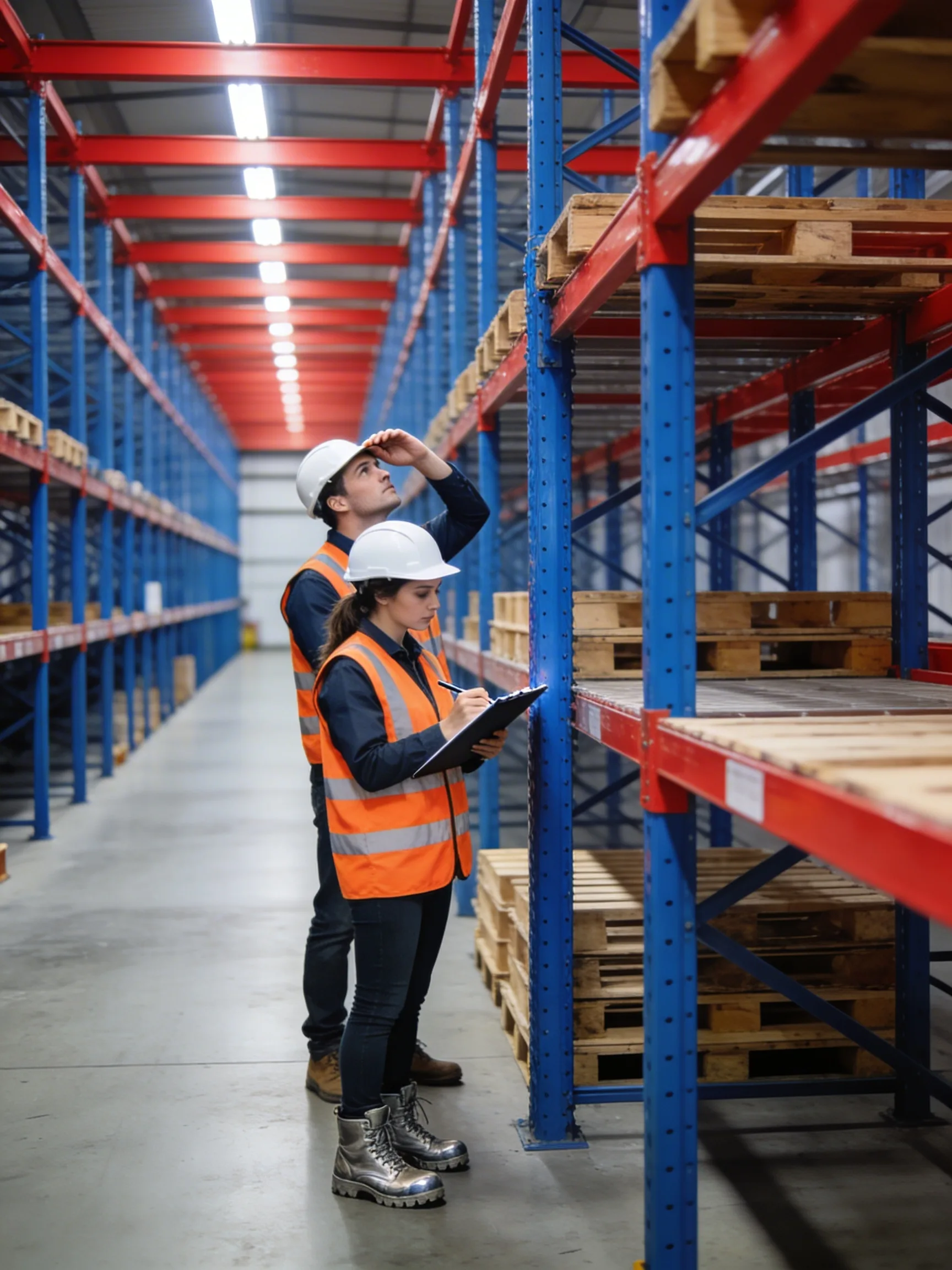
If you suspect your racking has sustained significant damage, take that section out of service immediately — offload the product and cordon off the area — before conducting any further evaluation. Never attempt to evaluate or repair damaged rack while it is loaded. DFW Pallet Racking provides emergency rack inspection and repair services throughout the DFW metroplex.
The ANSI/RMI Damage Classification System
The Rack Manufacturers Institute (RMI) ANSI/MH16.1 standard — the primary technical reference for pallet racking safety in the United States — establishes a three-tier damage classification system commonly referred to by the colors green, yellow, and red. While OSHA does not mandate use of this specific system, it is the industry standard referenced by qualified racking engineers and inspectors throughout the DFW market and nationally.
Understanding these three categories is the foundation of any repair-versus-replace decision. Each level carries different requirements for response timing, personnel qualification, and the types of corrective action that are appropriate. A common mistake warehouse operators make is treating all rack damage as a yellow-level issue when some conditions clearly warrant red-level response — and others can safely remain at green.
It is also important to note that damage classification is cumulative. A component that shows multiple minor deficiencies — none of which would individually reach yellow — may in combination warrant a yellow or even red classification. Evaluating components in isolation, rather than as part of the full system, can produce misleadingly optimistic assessments.
Green Level: Monitor and Document
Green-level damage represents minor deficiencies that do not materially affect the structural capacity of the component. Common green-level findings include superficial scratches or paint loss from incidental contact, minor dents in non-structural areas, and slight cosmetic bowing that falls within the acceptable tolerances defined by ANSI/RMI specifications. A single small indentation on an upright column face — less than 1/4 inch deep and not involving column perforation or significant section loss — might be classified as green.
Green-level damage does not require immediate corrective action, but it must be documented and monitored. The purpose of documentation is twofold: it establishes a baseline condition so that future inspections can determine whether damage is progressing, and it creates a paper trail that demonstrates your maintenance program is active and diligent. OSHA inspectors and insurance auditors view well-documented inspection records favorably, even when they contain records of minor findings.
The monitoring requirement for green-level damage is not passive. Each subsequent inspection should re-evaluate green items and determine whether they remain green or have progressed to yellow. In a high-traffic forklift environment — like many DFW distribution centers running multiple shifts — even minor damage can progress quickly if impacts continue in the same area. Column guards and end-of-aisle protectors are the most effective way to prevent green-level damage from accumulating in these environments.
Yellow Level: Repair Required, Load Reduction Possible
Yellow-level damage represents significant deficiencies that require corrective action within a defined timeframe — but do not require immediate removal from service. Yellow-level findings typically include column bending or deflection that exceeds ANSI/RMI tolerances but does not constitute imminent collapse risk, damaged beam end connectors with reduced but not fully compromised engagement, missing or damaged safety clips, and column base plates that are bent or partially detached but still providing some anchorage.
The appropriate response to yellow-level damage is typically one of two paths: repair the affected component within a defined timeframe (usually 30 days for most yellow findings), or reduce the load on that section until repair is completed. Load reduction provides a temporary safety margin while repairs are being scheduled and executed — it is not a substitute for repair, but it buys time to execute repairs without the disruption of an unplanned unload.
It is critical that yellow-level findings be formally documented with a specific repair commitment and timeline. Verbal acknowledgment is not sufficient. A signed inspection report identifying the damaged component, its classification, the required corrective action, and the target completion date creates a defensible record that demonstrates due diligence. If a rack failure later occurs involving a component with a documented yellow-level finding and no repair record, the liability implications are severe.
Red Level: Remove from Service Immediately
Red-level damage requires immediate removal from service. No continued loading of the affected section is acceptable, regardless of operational inconvenience or cost. Red-level findings include severely bent or buckled upright columns where the bend exceeds ANSI/RMI tolerances by a significant margin, fractured welds at structural connections, columns that have been struck and show visible deformation of the cross-section, base plates that have pulled out of or completely separated from the floor anchor, and beams that are visibly bent, twisted, or show cracked welds at the connection points.
In practice, red-level damage usually results from a significant forklift impact. A forklift traveling too fast at the end of an aisle, a load that shifts during travel and strikes an upright, or a pallet dropped from height — any of these can produce red-level damage in a single incident. The damage may not be immediately obvious to an operator, which is why post-impact inspection is mandatory and why forklift operators should be trained to report any rack contact immediately.
Red-level damage does not automatically mean the entire rack row must be replaced. Often, a red-level finding involves a single upright column or a specific beam connection, and replacing that component — combined with a qualified engineer's sign-off that the surrounding components are unaffected — is sufficient to return the system to service. What red level does mean is that the affected section cannot be used until the specific issue is resolved and a qualified person has confirmed the repair is adequate.
When Repair Is the Right Call
Component-level repair is appropriate when the damage is isolated to a specific element — a single upright column, a beam end connector, a specific base plate — and the surrounding structure is confirmed undamaged. Replacing a single damaged upright column with an identical OEM or compatible replacement column, performed by a qualified installer with proper anchoring, can restore the system to its original rated capacity at a fraction of the cost of full row replacement.
Post-impact upright protectors — column guards — are a common repair accessory that addresses base-level column damage while maintaining structural function. These steel guards bolt to the floor and surround the column base, protecting it from future forklift contact. They are appropriate for situations where a column has sustained cosmetic damage at the base but the structural properties of the column remain within tolerance. Column guards are not a structural repair and are not appropriate for columns with significant cross-section damage.
Repair also makes sense when the rack system is otherwise in good condition, relatively new, and the damaged component is readily available. If you have a five-year-old selective rack system in otherwise good shape and one column was struck by a forklift, replacing that column is almost certainly the right call. The economics of repair versus replacement are most clearly in favor of repair when damage is isolated, components are available, and the broader system has remaining useful life.
When Replacement Is the Right Call
Full replacement becomes the appropriate choice when damage is widespread across multiple components, when the system has accumulated damage over time to the point where repairs have become a recurring cost, or when the rack system is approaching end of useful life and the cost of repair approaches the cost of replacement with new, code-compliant, properly engineered product.
Used or older rack systems with unknown histories present particular challenges. If you inherited a rack system when you moved into a facility and don't have the original engineering documentation, load capacity certifications, or installation records, you cannot legally post load capacity ratings without a qualified engineer evaluating the system. If that evaluation reveals significant deficiencies or an inability to certify capacity, replacement with a new, fully documented system is often more cost-effective than the engineering work required to certify a substandard used system.
Replacement is also appropriate when the existing system is no longer a good fit for your operational requirements — for example, if your inventory has grown and you need additional capacity, if you've changed your forklift fleet and need different aisle configurations, or if your product has changed and existing beam configurations are no longer optimal. These operational-fit issues are separate from damage assessment, but they often create natural opportunities to replace aging or damaged systems rather than repair them.
Cost Comparison Framework
The financial comparison between repair and replacement is rarely straightforward, because costs on both sides extend well beyond materials and labor. On the repair side, you must account for the cost of the repair itself — components, labor, and any required engineering sign-off — plus the operational cost of offloading and reloading the affected area, plus the lost productivity during the repair window. For a single upright replacement in a well-organized facility, the total cost might be $500 to $1,500 including labor.
On the replacement side, a full rack row or multiple rows obviously costs more in materials and labor, but may qualify for different treatment under your capital expenditure budget versus your maintenance budget. Replacement also resets your inspection clock — a new system in good condition is far easier to manage and document than an older system with a history of repairs. And replacement with a new system provides the opportunity to upgrade capacity, change configuration, or improve aisle layout in ways that a repair cannot.
Insurance implications should also factor into the cost comparison. Some insurance carriers have begun asking about racking maintenance programs during policy renewals, and documented evidence of ongoing issues without adequate corrective action can affect coverage terms. A well-maintained, properly repaired, and inspected racking system is a better insurance risk than a system with a history of deferred maintenance — which matters when a rack-related incident triggers a workers' compensation or property claim.
Documenting Damage for OSHA Compliance
Maintaining written records of racking inspections, damage findings, and corrective actions is both an OSHA best practice and a practical liability management tool. An OSHA inspection that uncovers damaged racking without any associated documentation — no inspection records, no repair records, no evidence of a safety program — is a significantly more serious finding than one that encounters minor damage with a full paper trail showing active monitoring and timely response.
Effective documentation should record the date of inspection, the name and qualifications of the inspector, the specific location of each finding (bay, row, column number or grid coordinate), the classification of the finding (green, yellow, or red), the required corrective action, the target completion date, and the completion date when the action is taken. Photographs of findings are highly valuable and should be standard practice for any yellow or red-level finding.
DFW Pallet Racking provides written inspection reports that satisfy OSHA documentation requirements for warehouses throughout the DFW metroplex. Our reports identify every finding by location and classification, provide recommended corrective actions with priority ratings, and give you the documentation foundation you need for ongoing compliance management. Contact us or visit our rack inspection and repair services page to schedule an inspection, or see our pallet racking installation services if your assessment reveals that replacement is the right path forward.
Schedule a Professional Rack Assessment
Our certified inspectors evaluate racking systems throughout DFW, classify all damage according to ANSI/RMI standards, and provide written reports with repair recommendations and priority ratings.
Book a Rack AssessmentReady to Optimize Your Warehouse?
Get a free estimate from DFW's warehouse racking experts. We serve warehouses of all sizes throughout the Dallas–Fort Worth metroplex.